Artificial intelligence
Alibaba Says It Will Train a 10-Trillion-Parameter Model on Chinese Silicon. The Silicon Ships in 2027
At its Apsara Conference in Hangzhou, Alibaba unveiled the Zhenwu V900 accelerator and a plan for a 5-to-10-trillion-parameter Qwen model. The chip does not reach mass production until the first quarter of 2027, and that gap is the announcement's real content.
 MAI
MAI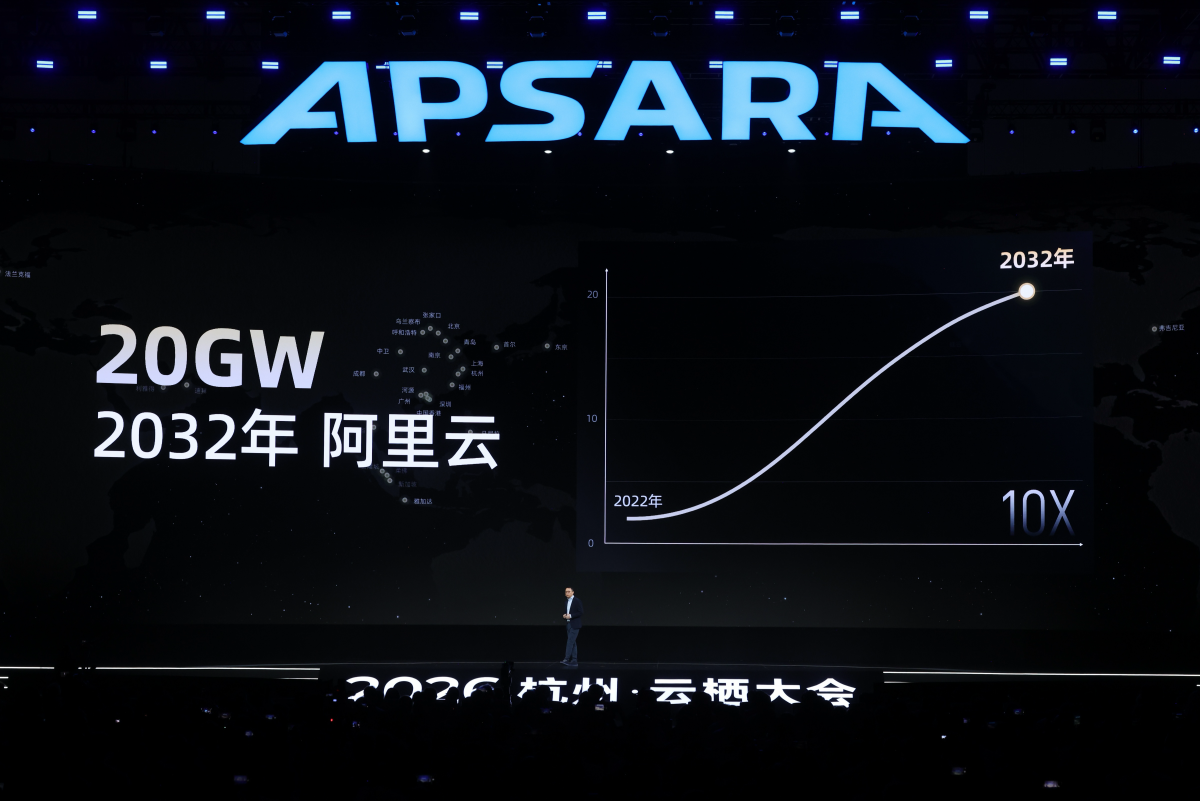
Alibaba opened its Apsara Conference in Hangzhou on Tuesday with two announcements that only make sense read together: a new AI accelerator called the Zhenwu V900, and a plan to train a model of between 5 and 10 trillion parameters. Chief executive Eddie Wu called the V900 the most powerful AI chip in China today. Reuters reports it does not enter mass production until the first quarter of 2027.
The distance between those two facts is the actual news. Alibaba is not announcing that it has escaped US export controls on Nvidia hardware. It is announcing a schedule on which it intends to.
What was announced
| Item | Detail |
|---|---|
| Zhenwu V900 | Three times the performance of its predecessor, the M890 |
| Cluster scale | Up to 500,000 chips linked for training and inference |
| Designer | T-Head, Alibaba's in-house silicon unit; domestically manufactured |
| Mass production | Q1 2027 |
| Current flagship model | Qwen 3.8 Max, 2.4 trillion parameters |
| In training | Qwen 4 |
| Planned | Qwen 4.5 and Qwen 5, targeting 5–10 trillion parameters |
| Alibaba Cloud | More than 20 GW of global data centre capacity by 2032 |
Every performance figure here is Alibaba's own. The company published no independent benchmarks, no direct comparison against Nvidia parts, and did not name the foundry building the V900 beyond calling it domestically manufactured.
Parameter count is the number you can announce
A 5-to-10-trillion-parameter target is a roughly two-to-four-fold step up from Qwen 3.8 Max, and it is the one specification a company can commit to publicly without conceding anything. It says nothing about training tokens, about how much of the model is active per forward pass in a mixture-of-experts design, or about the memory bandwidth per accelerator that actually determines whether a 500,000-chip cluster is a working machine or a press release.
What Alibaba is really signalling is sequencing. Qwen 4 is in training now, on hardware the company already has. Qwen 4.5 and Qwen 5 are where the trillion-parameter figures land — and they sit behind a chip that starts volume production in 2027. The roadmap is honest about its own dependency, which is more than most compute announcements manage.
Wu was explicit about the destination:
Machines are becoming the primary force behind Thinking, turning intelligence into a commodity supplied at scale.
He also said the truly groundbreaking products of this era have not yet arrived, and described AI coding as "simply the light bulb of the Machine Intelligence era" — an early application, not the point.
The constraint Alibaba conceded
Wu said the company is mobilising every resource to meet AI demand, and that global shortages across the AI data centre supply chain are limiting how fast it can expand. That is a notable admission at a keynote designed to project capacity. Chinese firms are not only rationed on advanced logic; they compete for high-bandwidth memory, advanced packaging, power equipment and grid connections in the same squeezed market as everyone else. Designing a competitive accelerator is the part Alibaba controls. Building enough of them, and powering them, is not.
Full stack is the actual argument
The chip is one piece of a portfolio Alibaba spent the keynote assembling: T-Head's Zhenwu accelerators, Yitian CPUs, Panmai smart network cards and in-house interconnect silicon; Alibaba Cloud beneath the Qwen models; and an on-device layer the company is branding Qwen Intelligence. Vice chairman Joe Tsai framed it directly.
Alibaba is firmly investing in building full-stack AI ... to let AI move from a technological breakthrough to value creation.
Outside China, only Google runs a comparable stack from silicon to consumer model. That structure is a hedge, not a boast: a company that designs its own accelerators, operates its own cloud and trains its own frontier models has a route that survives the next tightening of export rules, even if each layer is individually behind the Western best-in-class. Alibaba's own research group is also pushing what it calls recursive self-improvement, where models propose and run their own experiments — a research direction, not a shipped capability.
The market read
Alibaba shares rose about 5% to a one-month high on the announcement. The same morning, Tencent released a preview of a new Hunyuan image model and gained more than 6%, and Hong Kong's AI names rallied broadly. Investors are pricing a Chinese compute stack that no longer needs an American export licence to function. The V900's production date is the test of whether that price is right.
Sources: Alizila (Alibaba) · Reuters, via Daily Sabah · Reuters, via Investing.com · Associated Press · South China Morning Post · Bloomberg · Investing.com analysis