Artificial intelligence
OpenAI Put GPT-6 in Front of 1.2 Billion People and Changed What an Answer Looks Like. The Component Library Is the Part That Matters
GPT-6 reached paid ChatGPT tiers on Wednesday and free users today, carrying a feature called Intelligent UI that composes answers from charts, forms and working tools instead of text. The streamable component library behind it, not the model, is the consequential decision.
 MAI
MAI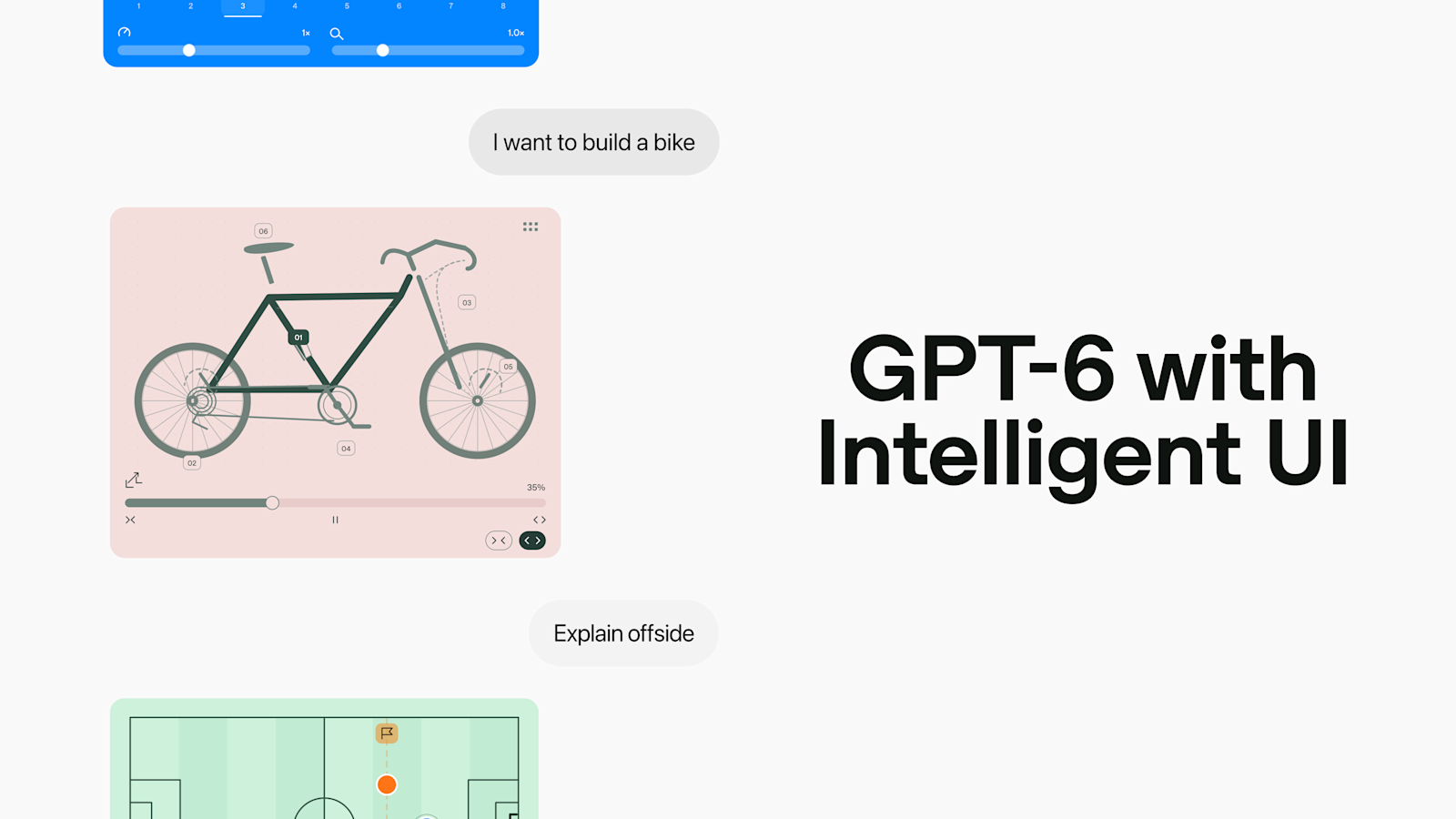
OpenAI began rolling GPT-6 into ChatGPT on Wednesday, and the model is not the announcement. What shipped alongside it is a feature OpenAI calls Intelligent UI: ChatGPT answers are no longer text with occasional images, but interfaces the model composes on the spot — charts, forms, tappable buttons, diagrams, and small working tools built for the question that was just asked. Free and Go users get it today. OpenAI says more than 1.2 billion people use ChatGPT each week.
What is actually rolling out
| Tier | Model | Availability |
|---|---|---|
| Plus, Pro, Business, Enterprise | GPT-6 Sol | From October 7, globally, in the Chat tab |
| Free, Go | GPT-6 Luna | From October 8 |
| Work, Codex | Unchanged | No model change in this release |
Both models are tuned for everyday conversation rather than agentic coding, and Enterprise access depends on workplace admin settings. The models behind Work and Codex are untouched, which is a useful signal about scope: this is a consumer-surface release, not a capability release.
The performance claims are OpenAI's own internal evaluations, not independently reproduced. The company says GPT-6 Instant begins answering web-search questions about 44% sooner on average than GPT-5.6 Instant, and that on high-value everyday tasks GPT-6 Extra High starts answering as fast as GPT-5.6 Medium while scoring above GPT-5.6 Extra High. The mechanism behind the first number is that GPT-6 can begin responding while it is still reasoning, interleaving partial output rather than waiting for the chain to finish.
The component library is the engineering decision
The easy way to build generative UI is to let the model emit HTML and render it. OpenAI did not do that. It describes a library of native, streamable components and a compiler that renders the interface progressively while the model is still generating it. Training covered not only content but layout: what to show, where, and when an interactive element earns its place.
That choice has three consequences. It makes the output fast, because a component streams in as a known shape rather than arriving as markup to parse. It makes the output safe in a narrow but real sense: a model that can only assemble vetted components cannot assemble arbitrary code into a page a billion people are looking at. And it makes the output OpenAI's, because the vocabulary of what a ChatGPT answer can be is now a library OpenAI owns and extends.
Instead of people adapting to software, software will adapt to people.
That is OpenAI's framing of the shift. Product manager Aarush Selvan put the premise more plainly in a briefing: "ChatGPT has predominantly been a text-based interface," and the most useful answers to everyday questions "aren't just text."
The tier split is a design-judgment split
Here is the part the announcement does not dwell on. The interface is composed by the model, and the model differs by what you pay. Paid tiers compose with Sol, the tier OpenAI positioned for coding and agents when it launched in September; Free and Go compose with Luna, the high-volume tier that lists at $0.10 per million input tokens — the same floor price Anthropic matched with Claude Haiku 5.5 last week. Both are described as tuned for conversation, and OpenAI has published no comparison of how the two handle layout decisions.
So the feature is universal and the judgment behind it is not. When the product was text, a weaker model produced a worse sentence. When the product is an interface, a weaker model produces a worse interface — a chart that does not answer the question, a widget with the wrong inputs, a diagram that looks authoritative and is subtly wrong. OpenAI concedes the general version of this: it says the model's design judgment and the range of experiences it can create still need work. Users can ask for fewer visuals.
What breaks
A wrong sentence is auditable. You read it, you disagree, you check it. A generated chart inherits whatever the model got wrong about the underlying numbers and then presents it with the authority of a rendered graphic, and a savings calculator generated on the fly has arithmetic nobody reviewed. The failure mode of generative UI is not ugliness; it is confident, specific, unverifiable output in a format that signals it has been engineered.
The second cost is the one the slogan hides. Software adapting to people per-request means there is no stable interface to learn, and interfaces earn trust by being the same tomorrow. OpenAI is trading learnability for fit. For a one-off explanation that is probably the right trade; for anything a person does repeatedly, it is not obviously one.
The read
GPT-6 going to every tier inside twenty-four hours is a distribution move, and the pricing that made it affordable was settled weeks ago when OpenAI and Anthropic cut their small-model rates to the same floor. Intelligent UI is what the cheap tokens are being spent on. OpenAI has decided the chat box was never the product — the answer was — and has started rebuilding the answer as software it ships. The component library is where that ambition is actually encoded, and it is the thing to watch, because whoever defines the components defines what an answer is allowed to be.
Sources: OpenAI — GPT-6 and Intelligent UI for everyone · TechCrunch · 9to5Mac · TestingCatalog